
Full-automatic walnut shelling and kernel extraction machine equipment consists of mechanical oil loading elevator, walnut shelling machine, sorting sieve, wind selection system, shell and kernel separation system and so on. Separate out the walnut shell and walnut kernel of the head road two road walnut kernel and three road four road walnut kernel
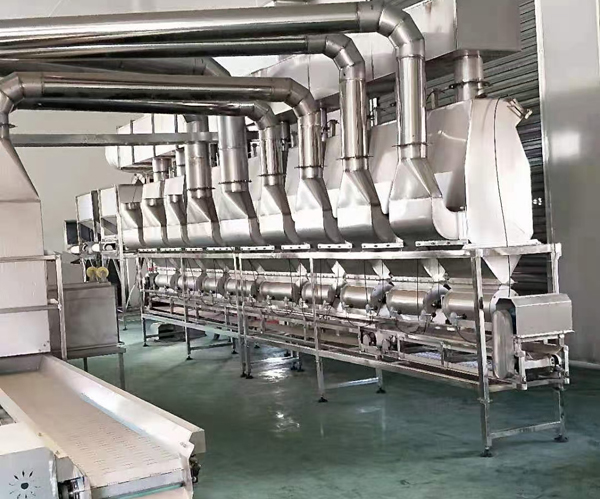
Composition machine of automatic walnut shelling and kernel extraction production line
The automatic walnut shelling and kernel extraction machine production line equipment includes mechanical feeding elevators, walnut shelling machines, sorting screens, air separation systems, shell and kernel separation systems, as well as how to separate the first and second paths of walnut kernels and the third and fourth paths of walnut kernels. Start by introducing the composition and functions of each device. For example, a mechanical feeding elevator might be responsible for sending walnuts into the production line, however
Next comes the shelling machine, which can be of the drum extrusion type or hammer type. The sorting screen can sort according to size or shape. The air separation system uses wind force to separate light and heavy substances. The shell core separation system may be further refined.
Next, the classification of walnut kernels into the first, second, third and fourth grades. For instance, “first grade” refers to half a walnut kernel. “First grade walnut kernel” is a term in the walnut industry, referring to high-quality walnuts
The kernel is plump in appearance and butterfly-shaped. It is a two-part kernel split in half and has a color of light yellow or light amber. Two-way walnut kernels refer to the fact that after the walnut is taken out of the shell, it is divided into four pieces, that is, one walnut is slightly broken into four pieces. Three-way walnut kernels are plump, the flesh is tender, the taste is sweet, the skin is thin and easy to peel, and it is convenient to eat. The four-way walnut is generally a mixed kernel and of similar quality
It is relatively poor.
The control system of the fully automatic production line involves PLC or sensors to ensure smooth processes. For large-scale fully automatic walnut shelling, kernel extraction and separation production line equipment, a dust removal system is also required.
The following is a detailed introduction to the composition, working principle and sorting process of the fully automatic walnut shell breaking and kernel extraction equipment, combined with the equipment functions, process characteristics and practical applications:
I. Detailed Explanation of the Composition and Functions of the Fully Automatic Walnut Shelling and Kernel Extraction Equipment
The function of the mechanical feeding elevator: It automatically lifts walnuts from the raw material silo or transport container to the entrance of the production line, achieving continuous feeding.
Structure and Principle:
Mechanical structure: It is usually a chain plate elevator, made of stainless steel or high-strength alloy materials, and equipped with an anti-jamming device.
Power system: Motor-driven, achieving low-speed stable transportation through a reducer to prevent walnuts from being damaged due to high-speed collisions during the lifting process.
Oil lubrication system: Some equipment adopts chain oil lubrication technology to reduce friction noise and extend the service life of the equipment.
Features:
Automated feeding reduces manual intervention and enhances efficiency;
Adjustable lifting speed to adapt to different production capacity demands;
The sealed design prevents dust from spilling out and meets environmental protection standards.
- Function of the walnut shelling machine: Separate the walnut shells from the kernels while preserving the integrity of the kernels.
Drum-type shelling machine
Structure: It is composed of two or more sets of rollers, with protrusions or grooves on the surface of the rollers. The walnut shells are cracked by the friction and pressure generated by rotation.
Advantages: High shelling rate, low kernel damage rate, suitable for large-sized walnuts.
Hammering type shelling machine
Structure: The walnut is struck by a high-speed rotating hammer head, and the shells are broken by the impact force.
Applicable scenarios: Small-scale production or hard-shelled walnuts, but the kernel breakage rate is relatively high (requiring subsequent sorting).
Combined shelling machine: By integrating a drum and hammering, it first lightly presses to break the shells and then lightly strikes to separate them, balancing efficiency and breakage rate.
Key parameters:
Rotational speed control (usually 15-30 revolutions per minute)
The roller gap is adjustable (0.5-2mm) to adapt to different walnut sizes.
Temperature control (to prevent kernels from deteriorating due to high temperatures).
Features:
Fully automatic feeding and discharging, reducing manual contact;
The parameters can be adjusted according to the walnut variety, offering high flexibility.
- Sorting screen function: It conducts preliminary sorting of the dehulled mixture (including shells, kernels, and crushed kernels) based on size and shape.
Type and Principle:
Vibrating screen
Structure: Multi-layer screen mesh (usually 3 to 5 layers), with the mesh size decreasing layer by layer (for example, the mesh size of the first layer is 8mm and that of the second layer is 5mm).
Working principle: Through high-frequency vibration, the material is stratified on the screen. Large particles (such as shell blocks) remain on the upper layer, while small particles (kernels, crushed kernels) pass through the lower layer.
Drum screen
Structure: Inclined drum, with comb teeth or grilles on the inner wall. When rotating, it separates materials of different sizes to different outlets.
Advantages: Suitable for handling materials with a high moisture content and reducing clogging.
Sorting grade:
Head kernel: Complete large kernel (diameter ≥12mm);
Two-sided kernel: Slightly smaller but intact kernels (8-12mm);
Three-way kernel: Broken kernels or partially damaged kernels (5-8mm);
Shells and impurities: Discharged through the residue on the sieve.
Features:
Multi-layer sorting, high efficiency;
The screen can be quickly replaced to adapt to different walnut varieties.
- Function of the air separation system: It uses air flow to separate light and heavy substances and further distinguish kernels from broken shells and impurities.
Structure and Principle:
Airflow generation device: A high-pressure fan generates controllable airflow, which is introduced into the sorting bin through pipelines.
Design of sorting bin
Chute type: The material slides along the chute. The light broken shells are blown to the upper outlet by the airflow, while the heavy kernels remain at the bottom.
Suspended type: Materials are suspended in the airflow and separated based on density differences (kernel density > shell density, sedimentation is faster).
Intelligent regulation: The wind speed is controlled by a frequency converter (typically 10-20m/s) to ensure precise separation of different particle sizes.
Sorting result:
Head kernel: Complete kernel (high density, not easily blown up);
Two-ply kernel: Light kernel or thin slices (partially damaged);
Broken shells and impurities: Discharged by air flow.
Features:
Non-contact sorting to avoid mechanical damage;
Adjustable wind speed to adapt to the characteristics of different materials.
- Function of the shell and kernel separation system: Thoroughly separate the remaining shells and kernels in the mixture to enhance purity.
Core technology:
Magnetic separation device: Removes iron impurities (such as metal debris from the wear of the shelling machine).
Photoelectric sorting machine
Principle: Identify the color/shape of the material through a camera or infrared sensor, distinguish the shell (light color) from the kernel (dark color), and blow out impurities through the air valve.
Advantages: High recognition accuracy (error < 0.5%), capable of handling particles larger than 0.5mm.
Electrostatic separation: By taking advantage of the difference in conductivity between the shell and the kernel, separation is achieved through an electric field.
Refinement of sorting grades
Head of the road: intact and undamaged, with uniform color;
Erlu Ren: Slightly damaged but edible;
Three-way kernel: Broken kernels or damaged skin;
Four types of impurities: broken shells, stones, unremoved pulp, etc.
Features:
It has a high degree of intelligence and reduces manual sorting.
It can be linked with the sorting screen and air separation system to form a closed-loop sorting.
Walnut kernel grading and screening machine standards and sorting process
Walnut kernel grading standard and sorting process
- Grading standard
First kernel: intact and unbroken, full kernel, no black spot or mould, diameter ≥10mm, used for high-end food, baking ingredients or export.
Second way kernel: slightly damaged but not completely broken, diameter 8-10mm, suitable for snacks, pastries and other mid-range products.
Three way kernel: broken kernel or skin off, diameter 5-8mm. used for pressing walnut oil or feed ingredients.
Four-way impurities: broken shells, stones, unpurified pulp, etc., need to be treated or recycled separately.
- Sorting process “
Raw material → Mechanical oil loading elevator → Husking machine → Sorting sieve (primary grading)
→ wind sorting system (light and heavy separation) → shell and kernel separation system (intelligent recognition)
→ grading output (headway, two-way, three-way, four-way)
Maintenance of walnut shelling and kernel extraction machine equipment
- Daily maintenance: clean the sieve mesh and air duct regularly to prevent clogging; check the wear and tear of the drum of the sheller and replace it in time; calibrate the sensor sensitivity of the photoelectric sorter.
- Troubleshooting: If the rate of kernel breakage increases suddenly, check the speed of the sheller or the clearance of the drum; if the efficiency of wind selection decreases, it is necessary to adjust the wind speed or clean the duct.