
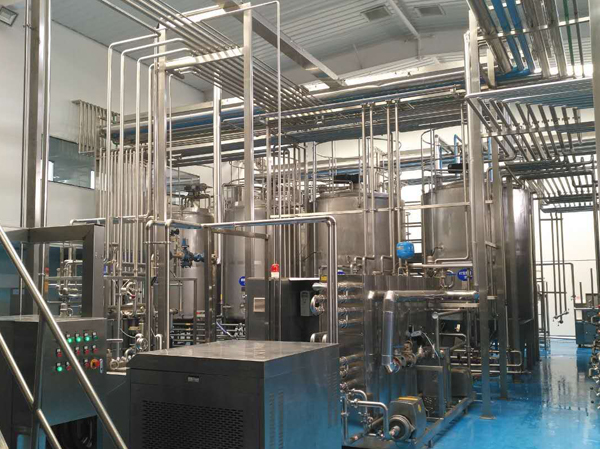
Reasons for excessive juice foam in juice making machine
Analysis and complete solution of excessive juice foam and overflow of enzymolysis/clarification tank in automatic juice production line
Root cause of juice foam
- Mechanical air intake: feeding spray, crushing and pulping, pump transportation, reflux impact on the liquid surface, excessive stirring, and a large amount of air mixed into the juice; Natural substances such as pectin, protein and saponin in fruit juice belong to foaming substances, which wrap bubbles to form stable foam.
- Enzymatic hydrolysis reaction produces gas: The process of pectinase decomposing pectin releases trace amounts of carbon dioxide; The raw materials decay and ferment with their own bubbles.
- Unreasonable tank feeding method: The material rushes directly to the liquid surface from a high position, causing severe impact on aeration; The reflux pipe sprays directly onto the liquid surface.
- The liquid level control in the tank is too high: the reserved foam buffer space is insufficient; The feed flow rate is greater than the defoaming and exhaust velocities.
- Temperature effect: the enzymolysis temperature increases, the viscosity of the juice decreases, the foam is more fluffy, the volume expands significantly, and it is easy to overflow the tank.
Core features: foam is light and bulky. Once it overflows the tank mouth, it will pollute the equipment floor and cause material loss. The overflow of foam will also trigger the interlock shutdown of liquid level protection and disrupt the rhythm of the whole production line; The introduction of foam into the subsequent sequence will cause membrane blocking, inaccurate filling and metering, and oxidation and browning of fruit juice.
Hierarchical control scheme for juice production line
- Front end reduces intake (fundamental solution)
- Change the feeding method: Insert the feeding tube below the liquid level (underwater feeding) to avoid material splashing and impact into the air; The reflux pipeline has also been changed to liquid reflux.
- Reduce pump cavitation intake: Do not idle the centrifugal pump, ensure that the suction port is full, and prevent air leakage in the pipeline; Add degassing pretreatment to the crushing and juicing section (placing the vacuum degassing machine after juicing and before enzymatic hydrolysis) to remove most of the free air in advance.
- Reduce the stirring speed: The enzymatic hydrolysis tank should be stirred with a low-speed paddle, and high-speed dispersion should be avoided; Just ensure that the materials are mixed evenly, without severe agitation.
- Control the feed flow rate: increase the feed control valve and feed slowly in the early stage; Do not pour large amounts of water into the tank in a short period of time.
- Physical defoaming inside the tank (no additive solution)
- Reserve enough foam safety space: set the safe liquid level of the tank, and reduce the maximum working liquid level by 20%~30% as the foam expansion allowance; Add high level foam alarm probe (foam type liquid level switch, not only measuring liquid), foam will automatically reduce the feeding when it reaches the alert position.
- Spray defoaming is installed on the top of the tank: an atomizing spray head is arranged on the top of the tank, and a small amount of sterile water/juice reflux spray is used to break the foam.
- Install defoamers and baffles; Large tanks can be added with mechanical defoamer (motor rotates at high speed to break foam), which is suitable for NFC clear juice products that are not allowed to add defoamer.
- A negative pressure exhaust/small vacuum interface is added on the top of the tank to timely remove the gas released by foam.
- Control of food grade defoamers (process aids)
- Food grade polydimethylsiloxane lotion allowed for fruit juice shall be selected and added in strict accordance with the national standard limit;
- Timing of addition: Crush and discharge the material or continuously add small drops into the enzyme hydrolysis tank inlet, do not pour in a large amount at once; Pre test to determine the optimal amount of addition to avoid excessive impact on subsequent filtration and aroma.
Attention: NFC high-end fruit juice should use minimal or no defoamers, and prioritize physical defoaming. - Optimization of enzymatic hydrolysis process parameters to reduce gas production and foaming
- Control the amount of enzyme preparation added: Do not overfeed pectinase, as excessive dosage will exacerbate the reaction and produce gas;
- Slow down the temperature rise rate of enzymatic hydrolysis, and do not cause the instant expansion of foam due to rapid temperature rise;
- During the early stage of enzymatic hydrolysis, keep the lid slightly ventilated and avoid completely sealing and accumulating pressure; Reduce the feed rate appropriately during the peak reaction period.
Troubleshooting of Juice Processing Machine
|Abnormal phenomenon | Reason | Rectification measures|
|A large amount of foam will rise as soon as feeding | high level spray feeding, impact entrainment | change to liquid feeding, reduce the feed drop|
|Foam suddenly rises after enzymolysis temperature rises | enzymolysis produces gas, temperature rises, foam expands | lower the maximum set liquid level; Slow warming; Open the tank top spray for defoaming|
|The foam often overflows and alarms frequently | The liquid level sensor only measures liquid and cannot detect foam | The foam liquid level alarm is added and interlock flow reduction is set|
|Poor defoamer effect | Delayed addition timing, one-time rapid addition | Continuous and quantitative dripping of defoamer in the feed pipeline|
|Foam brought to ultrafiltration and filtration equipment | insufficient degassing at the front end | vacuum degassing process added after juice pressing|
Emergency response plan
- Immediately interlock to stop the feed pump and reduce the mixing speed;
- Open the tank top spray for defoaming and let it stand for defoaming;
- If there is too much foam, the material can be temporarily transferred to the standby buffer tank for pressure relief and defoaming;
- Spilled materials cannot be recycled into the product to avoid microbial contamination.
Long term optimization suggestions for juice making machine
An online vacuum degasser is arranged between the juice squeezing tank and the enzymolysis tank to remove the dissolved air in the juice from the source, greatly reduce the foam pressure of the enzymolysis tank and clarification tank in the rear section, reduce the dependence on defoamers, and improve the browning problem of the juice, killing two birds with one stone.