
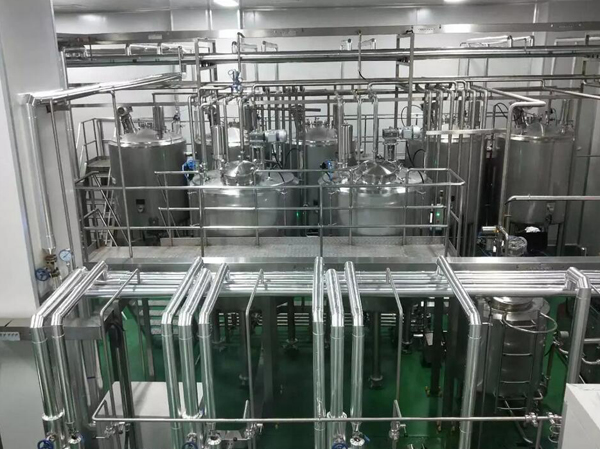
Concentration section of juice production line: analysis and complete solution for secondary steam carrying, material loss, and condenser scaling problems
Phenomenon description
When the evaporator (multi effect falling film/rising film concentration) evaporates, the secondary steam carries small fruit juice droplets, fruit pulp, and sugar into the condenser:
- Effective juice is lost with condensed water, resulting in a decrease in material yield and cost loss;
- Sugar, pectin, and organic acids adhere to the condenser tube wall, forming a sticky scale layer;
- Scaling leads to decreased heat transfer efficiency, unstable vacuum degree, increased energy consumption, and shortened cleaning cycle; Severe blockage of pipelines and significant increase in CIP cleaning load.
The fundamental reason for its occurrence
- Poor vapor-liquid separation effect (core)
Improper selection, blockage, damage, and excessive installation clearance of the vapor-liquid separator (demister) at the top of the evaporator; The evaporation flow rate is too high, and the droplets are carried out by high-speed steam. - Juice foam problem superposition
Fruit juice pectin and protein foam, a large amount of foam inside the evaporation tank, foam is directly swept away by the secondary steam; Feed foam is not degassed and eliminated in the front section. - Operating process parameters exceed the standard
-The single effect evaporation load is too high, the evaporation temperature is too high, the vacuum fluctuates violently, and the material liquid boils violently and explosively;
-The feed flow rate is unstable, the liquid level control is too high, and the liquid level is too close to the steam outlet;
-The concentration of solid matter in fruit juice fluctuates, and the higher the concentration, the greater the viscosity, making it easier to foam and entrain. - Defects in the equipment itself
-Mismatch of demister type (simple baffle type, unable to capture small droplets); The wire mesh demister is clogged and compacted by pectin after long-term use;
-The evaporator distributor is damaged, the film distribution is uneven, and there are splashing droplets on the local dry wall;
-The steam flow rate design exceeds the rated operating conditions of the equipment. - The condenser structure and reflux recovery are missing
The juice carried in does not reflux back to the evaporator and directly enters the condensate water; The accumulation and solidification of dirt over a long period of time make acid/alkali washing more difficult.
Graded Rectification Plan
- Strengthen vapor-liquid separation (fundamental)
- Upgrade/repair the foam removal device
-Prioritize the use of a two-stage separation system consisting of a wire mesh demister and a baffle; Efficient wire mesh for juice cleaning; The juice with trace fruit pulp is treated with a corrugated plate defogger, which is not easily clogged;
-Regularly disassemble and inspect the wire mesh for blockage, deformation, and collapse; CIP must be able to spray and rinse onto the demister to prevent pectin from drying out.
-Ensure that the installation of the demister is sealed and leak free to prevent steam from short circuiting and bypassing the demister unit. - Control the reasonable liquid level inside the tank
The liquid level in the evaporation tank shall not be too high to reserve space for foam and fog drop settlement; Set up high and low liquid level interlock, automatically reduce feed and evaporation power when the liquid level is too high. - Optimize the operating parameters of the evaporation process
- Control evaporation load and prohibit overloading production; Do not forcefully increase the vacuum for rapid evaporation to avoid severe boiling.
- Pre degassing and defoaming of feed: Front end vacuum degassing reduces dissolved gases inside the juice and lowers boiling and foaming; If necessary, the front end micro compliant defoamer controls foam.
- Smooth control of temperature and vacuum degree to avoid sudden spraying caused by severe pressure/vacuum fluctuations; Adjust the temperature and load gradually.
- Control the stability of solid matter in the feed to avoid severe foaming and entrainment caused by high feed volume of low concentration fruit juice.
- Increase the collection and recycling system to reduce material loss
- Add a droplet capture tank (reflux collection tank) between the evaporator and condenser, and the separated juice will flow back to the evaporator by gravity;
- Add sampling monitoring and online Brix detection on the condensate side: once the sugar content of the condensate is detected, it can quickly determine material leakage and stop the machine in time to check the demister;
- Collect the condensate separately and evaluate whether it can be reused as cleaning water (strictly prohibit backflow into the product, as there is a risk of microbial contamination).
- Control and Cleaning Plan for Condenser Scaling
- Reducing material carryover at the source is the most critical means of delaying scaling; As long as the steam does not contain juice, the condenser will only have scale, making cleaning simple.
- Optimize CIP cleaning program:
-Alkaline washing (removing pectin and organic sugar deposits) → rinsing with clean water → acid washing (removing mineral scale) → final rinsing;
-Ensure sufficient flow rate of cleaning solution to flush the heat exchange tube wall; Regularly disassemble and inspect the blockage of heat exchange plates/tubes. - Shorten cleaning cycle warning: When the vacuum degree decreases, the heat exchange temperature difference increases, and the steam consumption increases, as a scaling warning signal, arrange cleaning in advance and do not wait for severe scaling.
Quick comparison table for faults
|Abnormal phenomenon | Root cause | Improvement measures|
|The sugar content of condensed water is measured, and the material is damaged. The demister is malfunctioning/blocked, and the steam flow rate is too high. The high-efficiency demister should be repaired and replaced; Reduce evaporation load; Stable vacuum|
|There is a lot of foam inside the evaporator, and the material is frequently carried | the juice is not degassed, and there are many foaming substances | the front end is vacuum degassed; Control defoaming; Reduce the liquid level inside the tank|
|The condenser quickly forms sticky organic scale | continuously carries trace amounts of juice for a long time | increases the intermediate capture reflux tank; Online monitoring of condensate water Brix|
|CIP cleaning is not clean, and the heat exchange effect is poor. Pectin solidifies at high temperatures and forms coke. Strictly follow the principle of alkaline washing to remove organic matter before acid washing|
Key points for daily maintenance and inspection
- Check the cleaning status of the demister after each CIP;
- Sampling and testing the sugar content of condensate water during shift handover, and establishing a monitoring ledger for material running;
- The load of the multi effect evaporator cannot operate beyond the design capacity for a long time;
- Regularly inspect the material distributor to ensure even film distribution and reduce dry wall splashing.